Nature#
Summary#
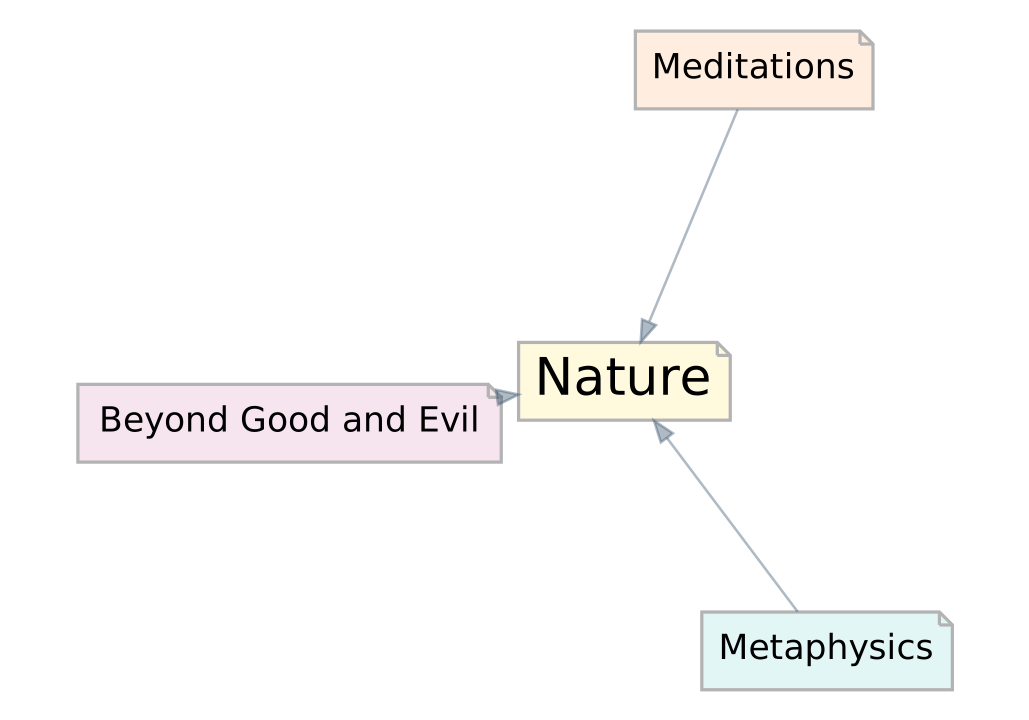
In the Meditations, nature represents the universal ordering principle that governs the cosmos, to which humans belong as parts of a greater whole. Living according to nature means accepting one’s role within this system and recognizing that whatever the universe assigns is ultimately for the advantage of the whole. Nietzsche in Beyond Good and Evil challenges this Stoic conception, arguing that nature is boundlessly indifferent and that the imperative to “live according to nature” is a self-deception through which philosophers project their own ideals onto the world.
Mentioned In#
Meditations#
- IX.30 ↖ Book IX
- IX.32 ↖ Book IX
- IX.36 ↖ Book IX
- X.2 ↖ Book X
- X.3 ↖ Book X
- X.4 ↖ Book X
- X.7 ↖ Book X
- X.8 ↖ Book X
- X.16 ↖ Book X
- X.17 ↖ Book X
- X.20 ↖ Book X
- X.22 ↖ Book X
- X.23 ↖ Book X
- X.36 ↖ Book X
- X.40 ↖ Book X
- XI.5 ↖ Book XI
- XI.17 ↖ Book XI
- XI.20 ↖ Book XI
- XI.23 ↖ Book XI
- XI.25 ↖ Book XI
- XI.49 ↖ Book XI
- XII.1 ↖ Book XII
- XII.15 ↖ Book XII
- XII.24 ↖ Book XII
- XII.26 ↖ Book XII
- XII.35 ↖ Book XII
- XII.39 ↖ Book XII